
Choose from the product, not only the machine price
When buyers start looking for a hot stamping machine, the first question is often the machine price. Price matters, but it should not be the first selection point. For packaging products, the right machine depends on product type, material, stamping pattern, production volume, positioning requirement, and target effect.
A setup that works for a flat paper box may not be suitable for a plastic cap or an irregular packaging component. A machine used for small logos may not be the best choice for large-area foil stamping. Start with the real product and work back to the machine configuration.
After the product and machine direction are clear, use the hot stamping machine sizing guide to separate product dimensions, active transfer area, fixture footprint, worktable space, opening height, and loading access before confirming a specification.
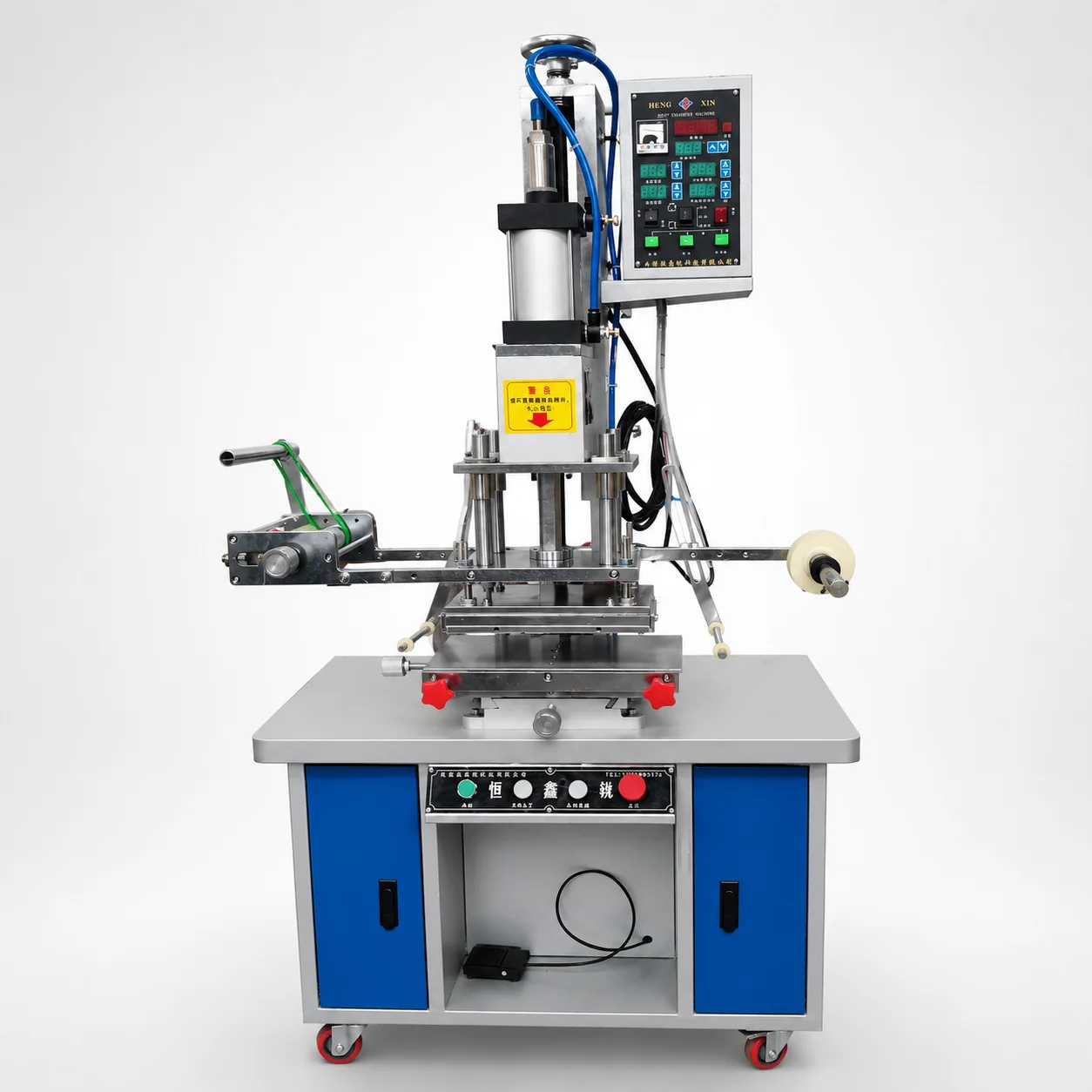
Quick selection flow
Five details decide the machine direction
- Confirm the packaging product type, size, surface shape, and stamping position.
- Check whether the material and coating can accept foil under heat and pressure.
- Match pressure, die quality, and positioning accuracy to the logo, text, border, or foil area.
- Choose manual, pneumatic, semi-automatic, or automatic operation according to real production volume.
- Confirm fixture needs and sample results before treating the machine configuration as final.
1. Start with the packaging product
The first question is not which machine is cheaper. It is: what packaging product needs to be hot stamped? Different products require different worktable space, fixture design, pressure, stroke, and positioning method.
Flat boxes and cards
Paper boxes, gift boxes, labels, cards, and flat rigid packaging are often easier to position. A flatbed manual or pneumatic hot stamping machine may be a practical starting point.
Rigid or thick packaging
Wine boxes, cosmetic boxes, and thicker gift packaging need enough table space, stable pressure, and a loading method that protects the product shape.
Caps and small parts
Bottle caps, plastic caps, closures, and small accessories often need a custom jig so the part stays steady during the stamping cycle.
Before asking for a recommendation, prepare product photos, dimensions, product thickness, surface shape, stamping position, and whether the surface is flat, curved, recessed, or irregular.
2. Check material and surface suitability
Hot stamping quality does not depend only on the machine. The substrate, coating, foil, die, temperature, pressure, and dwell time must work together. Some surfaces accept foil easily, while others need testing before production.
- Ordinary paper and many coated papers are commonly used for boxes, cards, labels, and packaging panels.
- Laminated paper depends on the film surface; some films allow good adhesion, while others need testing.
- Textured or specialty paper may need careful pressure, foil, and temperature adjustment.
- Plastic parts should always be tested because heat and pressure can affect different plastics differently.
Even with a suitable machine, the wrong foil or an incompatible surface can cause weak adhesion, missing transfer, blurred edges, or product damage.
3. Match the machine to the stamping pattern
A small logo, fine text, large foil area, and decorative border each place different demands on the machine. This affects pressure capacity, die quality, temperature control, fixture accuracy, and operator adjustment.
Small logos
Focus on clean foil transfer, stable pressure, and repeatable positioning on the packaging surface.
Fine text
Check die quality, temperature control, and pressure balance so thin strokes do not blur or break.
Large foil areas
Confirm pressure capacity and platform stability so transfer is even across the full design.
Border lines
Positioning accuracy matters because even a small shift can make a frame or edge line look uneven.
Curved surfaces
A standard flat stamping method may not be enough when the decoration area is round or uneven.
Artwork review
Send logo size, line thickness, stamping area, target position, and tolerance requirements early.
4. Choose automation level from production volume
A machine used for sample testing is not the same as a machine planned for stable mass production. The best choice is not always the most automated option; it is the option that fits the product stability, batch size, operator plan, and investment stage.
| Production situation | Machine direction |
|---|---|
| Sample testing, trial orders, or low-volume customization | Manual hot stamping machine for flexible operation and lower tooling risk |
| Small to medium regular orders | Pneumatic hot stamping machine for more stable pressure and repeatability |
| Stable product with fixed stamping position and high output demand | Semi-automatic or automatic equipment after the product specification is clear |
| Products change frequently | Manual or pneumatic configuration, because adjustment flexibility may matter more than speed |
5. Do not ignore fixtures and positioning
For packaging products, the fixture is often as important as the machine itself. A fixture holds the product in the correct position during stamping. If the product moves, even a good machine cannot produce a clean and repeatable result.
Fixtures are especially important for bottle caps, plastic caps, small accessories, irregular packaging parts, rigid boxes, curved surfaces, and products requiring precise logo placement. A well-designed jig can reduce rejected products and make operator loading easier.
6. Define the final stamping effect
Some packaging projects need a simple gold logo. Others need silver foil, metallic color foil, holographic foil, matte foil, glossy foil, border lines, or a premium decorative branding effect. The final look depends on the machine, foil, mold, material, temperature, pressure, and dwell time.
This is why sample testing is important before mass production. A useful sample review should check edge clarity, adhesion, gloss, position repeatability, product surface condition, and whether the result matches the buyer's visual standard.
Inquiry checklist
What to send before asking for a machine recommendation
- Product photos, dimensions, material, surface shape, and thickness.
- Stamping artwork, logo size, stamping area, foil color, and target position.
- Expected production volume, operator plan, voltage requirement, and destination country.
- Target effect, existing sample standard, or photos of the result you want to match.
Simple buyer guide
| Product or requirement | Key concern | Possible direction |
|---|---|---|
| Flat paper box or card | Positioning and clear foil transfer | Flatbed manual or pneumatic hot stamping machine |
| Gift box or rigid box | Product thickness and working space | Machine with suitable table space and stable pressure |
| Plastic cap or bottle cap | Fixture, material, and surface shape | Pneumatic or customized hot stamping setup with sample-tested jig |
| Fine text or border lines | Die quality, temperature control, and position repeatability | Machine with precise adjustment and stable fixture support |
| Large-volume fixed product | Efficiency and consistency | Semi-automatic or automatic equipment after sample confirmation |
Related PackFinish pages
- Review the gift box hot stamping machine buyer checklist
- Compare manual, pneumatic, hydraulic, and automatic hot stamping machine types
- Check which packaging materials can be hot stamped before ordering a machine
- Review the manual / semi-automatic hot stamping machine page
- Compare heat transfer and hot stamping machine options
- Read the wine box hot stamping machine guide
- Check common hot stamping problems before buying
- Follow the workflow from sample review to pre-delivery confirmation
FAQs about choosing a hot stamping machine
What type of hot stamping machine is suitable for paper boxes?
For many flat paper boxes, a flatbed manual or pneumatic hot stamping machine may be suitable. The final choice depends on box size, stamping area, material surface, fixture needs, and production volume.
Can plastic caps be hot stamped?
Many plastic caps can be hot stamped, but testing is important. The result depends on plastic material, surface shape, foil type, temperature, pressure, and fixture design.
Is an automatic hot stamping machine always better?
No. Automatic equipment is more suitable for stable, high-volume production. If products change often or order quantities are small, a manual or pneumatic machine may be more practical.
Why should samples be checked before recommending a machine?
Samples help confirm product shape, material, stamping position, foil adhesion, fixture requirements, and the final visual effect. This makes machine selection more accurate.
Choose the machine from the product requirement
The right hot stamping machine for packaging products is not chosen by price alone. It should match the product type, material, design, production volume, fixture requirement, and final effect.
For small batches, a manual or pneumatic hot stamping machine may be enough. For stable, large-volume packaging production, semi-automatic or automatic equipment may be a better direction. Before making the final decision, test the real product and confirm the stamping result.
Send your packaging samples and requirements to PackFinish so the product, artwork, material, volume, and target effect can be reviewed before recommendation.