
Many buyers start with a simple question: can my packaging material be hot stamped?
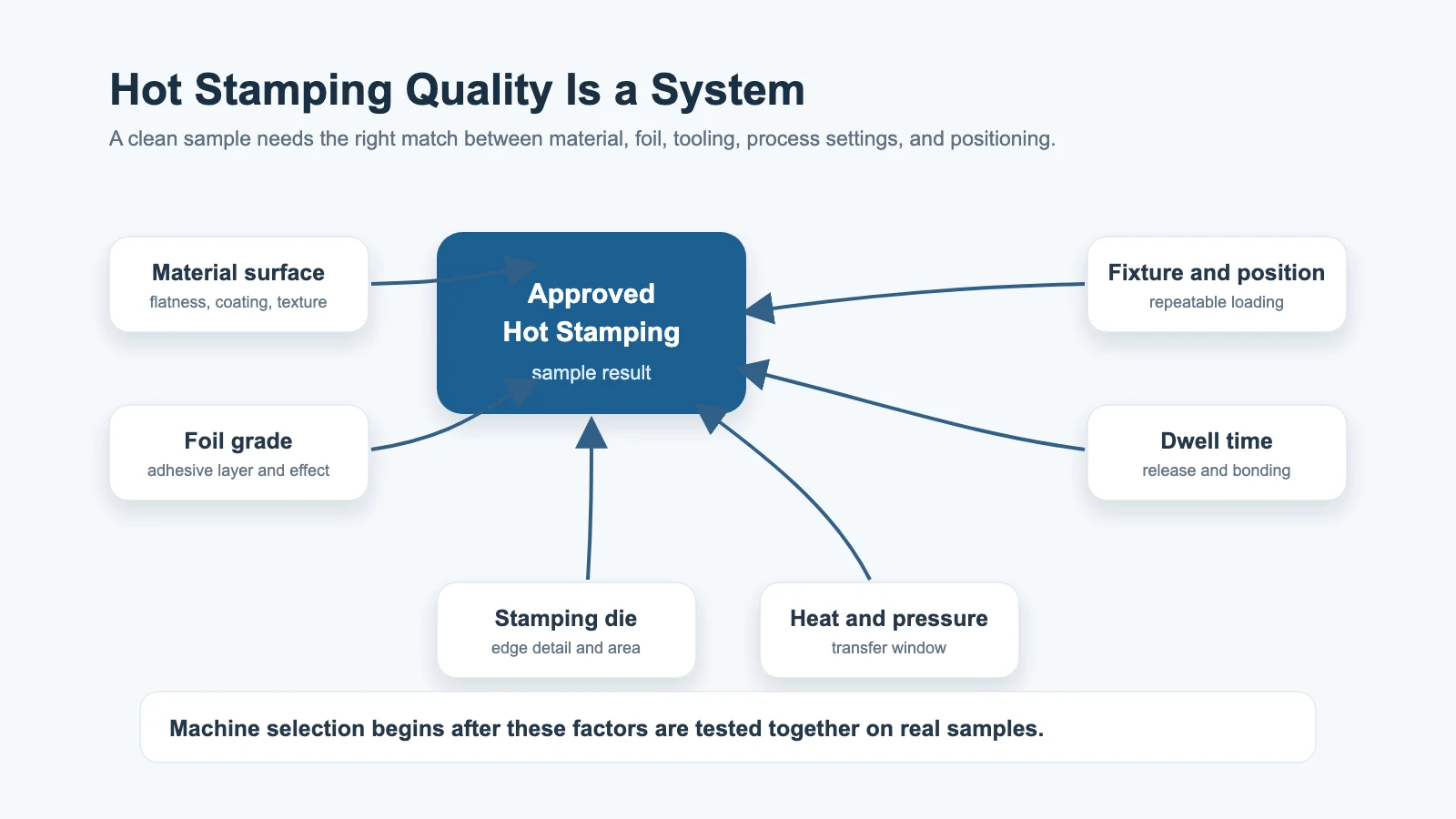
The honest answer is that it depends on the exact material, surface finish, coating, shape, artwork size, foil grade, and machine configuration. A hot stamping machine does not work in isolation. The final result comes from the combination of heat, pressure, dwell time, hot stamping foil, stamping die, fixture, and material surface.
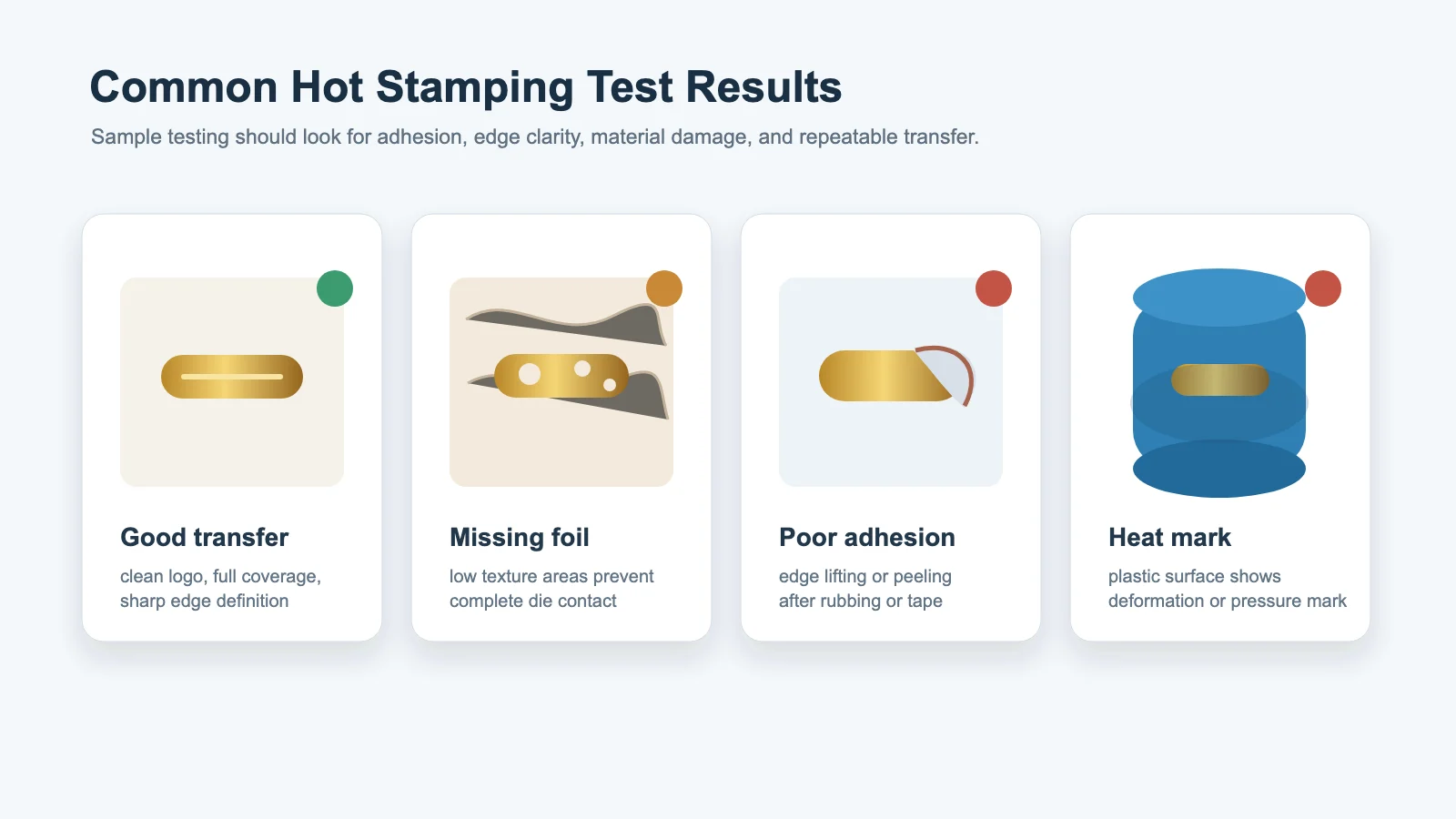
That is why the same machine may produce a clean gold logo on one paper box, but show weak adhesion, missing foil, blurred edges, or heat marks on another material. Before ordering a hot stamping machine, the safer approach is to test real samples instead of judging only from product photos.
Once the top surface is identified, use the PackFinish guide to select hot stamping foil for paper, laminated board, and plastic surfaces by release, coverage, adhesion, and sample-test results rather than color alone.
Quick answer
Most packaging materials can be tested, but not all are production-ready
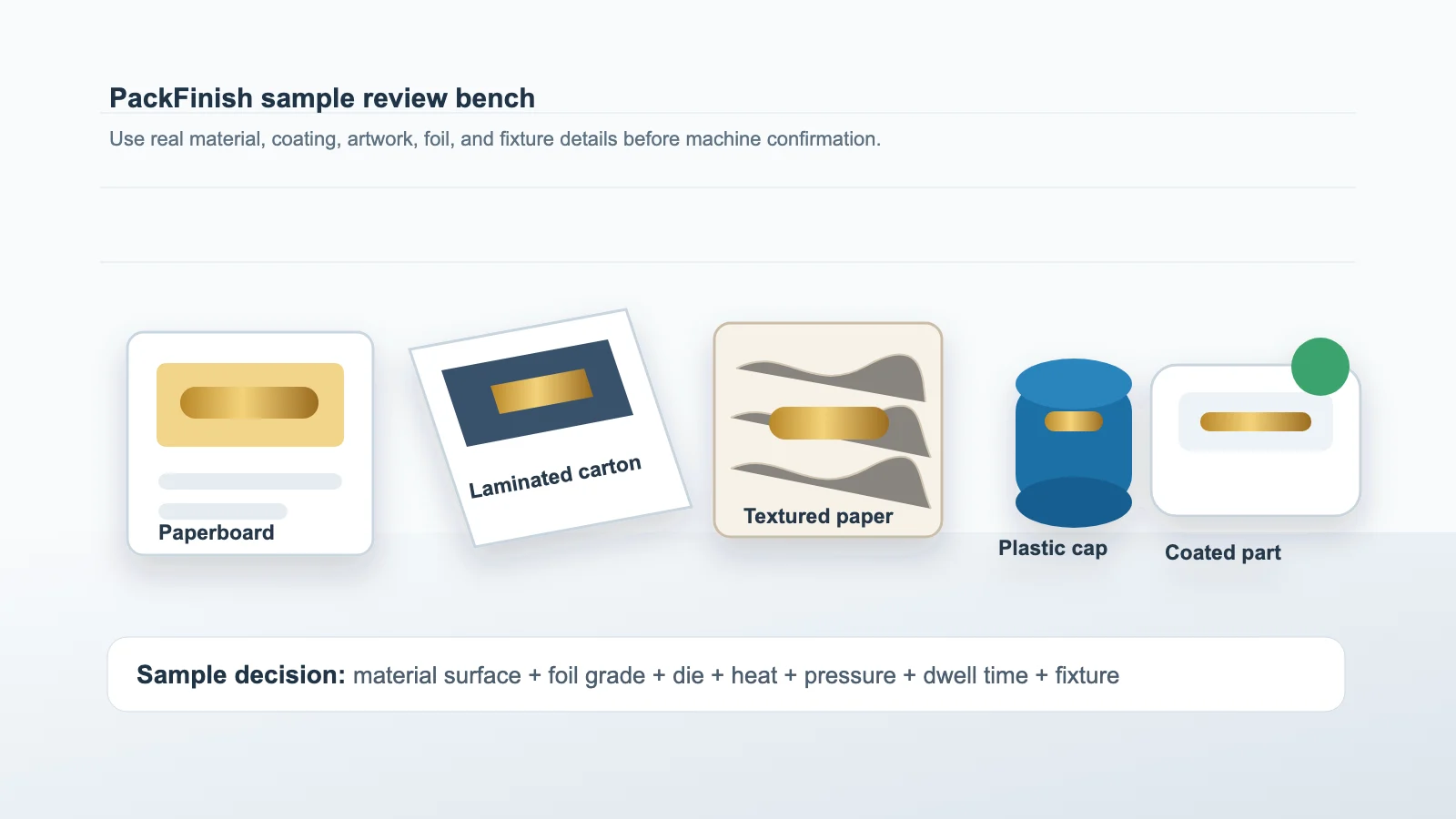
Common packaging materials that can be tested include paperboard, coated paper, laminated paper, textured paper, rigid box wrapping paper, plastic caps, closures, coated plastic parts, and painted surfaces.
But "can be tested" is not the same as "ready for production." A buyer should confirm foil transfer, adhesion, edge clarity, heat resistance, positioning, and repeatability before treating a material as suitable.
For buyers comparing machine options, this article is the material-testing companion to PackFinish's guide on how to choose the right hot stamping machine for packaging products.
If the project already involves a plastic cap, paper box, or laminated surface, continue with the material-specific hot stamping test-plan comparison. It explains how the evidence and support conditions should change across those three structures.
Common packaging materials that can be tested for hot stamping
Hot stamping is widely used in packaging decoration because it can create metallic, glossy, matte, holographic, and special visual effects without ordinary ink printing. But every surface reacts differently.
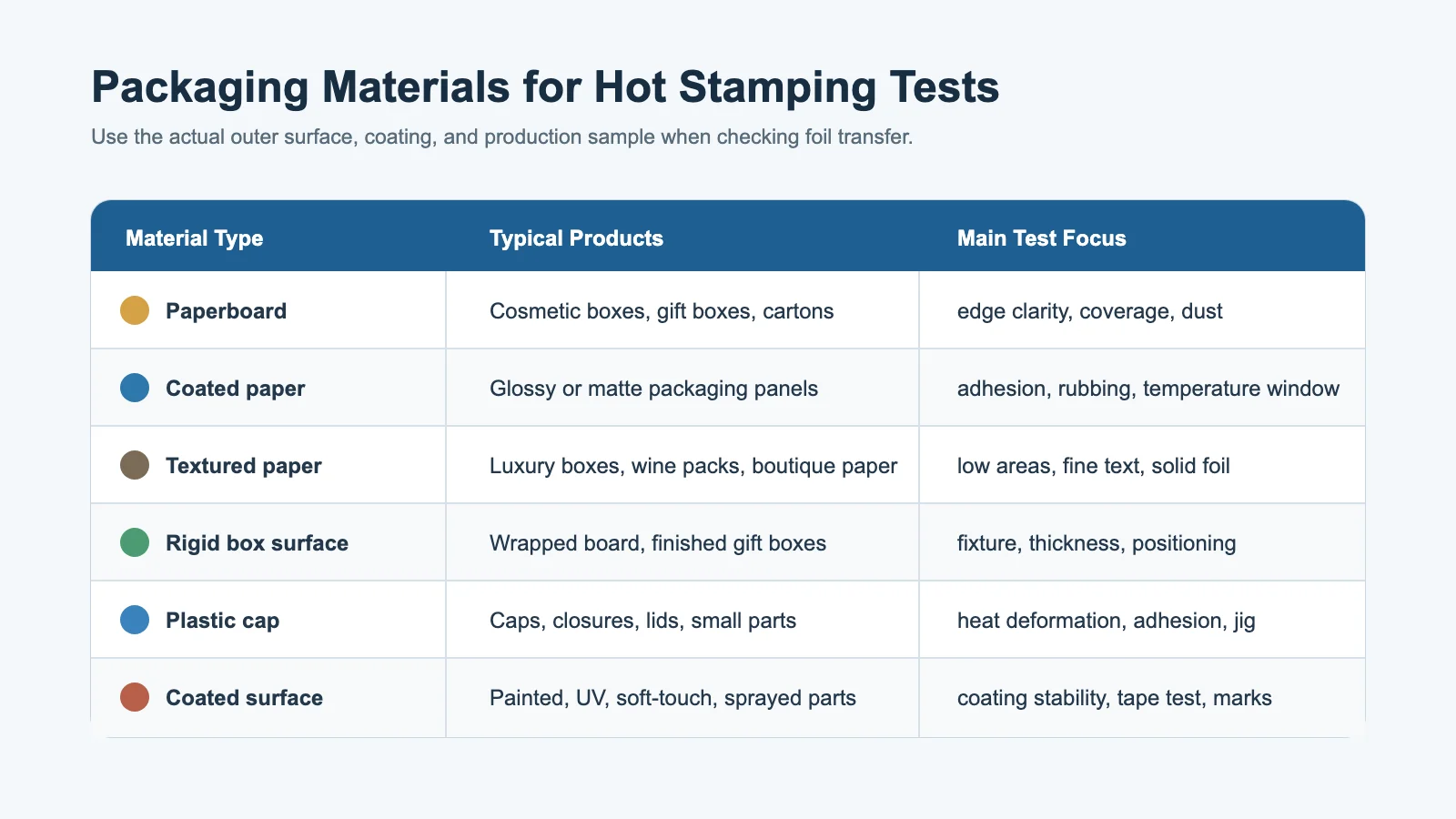
Paperboard and folding cartons
Paperboard is common for cosmetic boxes, gift boxes, food packaging, pharmaceutical cartons, wine boxes, and retail packaging. Smooth paperboard usually gives better die contact, but coating, ink, and varnish still affect the result.
Coated and laminated paper
Glossy paper, matte laminated paper, and film-laminated cartons can look premium, but the foil must bond to the surface layer. Some coatings peel, crack, or transfer unevenly.
Specialty and textured paper
Soft-touch, rough, pearlescent, fiber-textured, or embossed papers can look excellent after hot stamping, but low texture areas may miss foil, especially with fine text or large solid areas.
Rigid box surfaces
Rigid box tests should focus on the actual outer wrapping surface, not only the inner board. Box thickness, structure, and loading method may affect fixture design and machine choice.
Plastic caps and closures
Caps, closures, tubes, lids, and small decorative plastic parts may be hot stamped, but PP, PE, PET, ABS, acrylic, PVC, and coated plastics may require different foil grades or surface treatment.
Coated or painted surfaces
Paint, UV coating, soft-touch coating, varnish, and sprayed layers change the bonding surface. If the coating itself is weak, the foil may peel even when the machine setting looks correct.
Material factors that affect hot stamping results
When a buyer says, "my product is paper" or "my cap is plastic," that information is not enough. The key question is what exact surface the foil must transfer onto.
| Factor | Why it matters |
|---|---|
| Surface flatness | Rough, curved, recessed, warped, or uneven surfaces can cause broken lines, missing foil, unclear edges, or uneven brightness. |
| Coating and lamination | Glossy coating, matte film, soft-touch lamination, UV varnish, or anti-scratch coating can change foil adhesion. |
| Ink layer and printed background | If foil is applied over printed ink or varnish, the foil bonds to that layer instead of raw paper. |
| Heat resistance | Plastic parts may deform, soften, shrink, or show pressure marks if temperature, pressure, or dwell time is not controlled. |
| Surface adhesion | Low surface energy plastics, mold release residue, weak coatings, or incompatible foil adhesive layers can cause peeling. |
| Product shape and positioning | A finished box, cap, tube, or molded part may need a custom fixture so the product stays in position during stamping. |
For flat cartons, a manual or semi-automatic hot stamping machine may be suitable. For curved plastic parts, roller stamping, silicone tooling, or a customized fixture may be needed.
Common risks by material type
Different materials create different problems. Buyers should understand the likely risk before ordering a machine or approving mass production.
Ordinary paper and paperboard
Usually easier to hot stamp when smooth and clean, but dusty paper, recycled board, or loose fiber surfaces may still cause uneven brightness or weak edge definition.
Main test focus: edge clarity, foil coverage, dust contamination, consistency.
Glossy coated paper
Can produce a bright foil effect, but the foil must bond properly to the coating layer. Some coatings are too smooth or unstable under heat.
Main test focus: adhesion, temperature window, edge sharpness, rubbing resistance.
Matte laminated or soft-touch paper
Popular for premium packaging, but some soft-touch films resist adhesion or show visible pressure marks after stamping.
Main test focus: foil adhesion, heat marks, pressure marks, surface damage.
Textured paper
Can look attractive with foil stamping, but texture can prevent full contact. Fine text may break and large areas may show missing dots.
Main test focus: small logo, fine text, large solid area, low texture areas.
Plastic caps and closures
Plastic parts need careful evaluation because heat, pressure, surface shape, and fixture design affect both appearance and adhesion.
Main test focus: heat deformation, adhesion, scratch resistance, curved-surface transfer.
Coated or painted plastic parts
Foil may bond to the paint or coating layer. If that layer is weak, the final decoration may fail even when the foil transfers clearly.
Main test focus: coating stability, tape test, rubbing test, alcohol or oil resistance.
Key tests before ordering a hot stamping machine
A buyer should not confirm the machine only by sending a product photo. Photos can show the shape and design, but they cannot prove adhesion, heat resistance, or production stability.
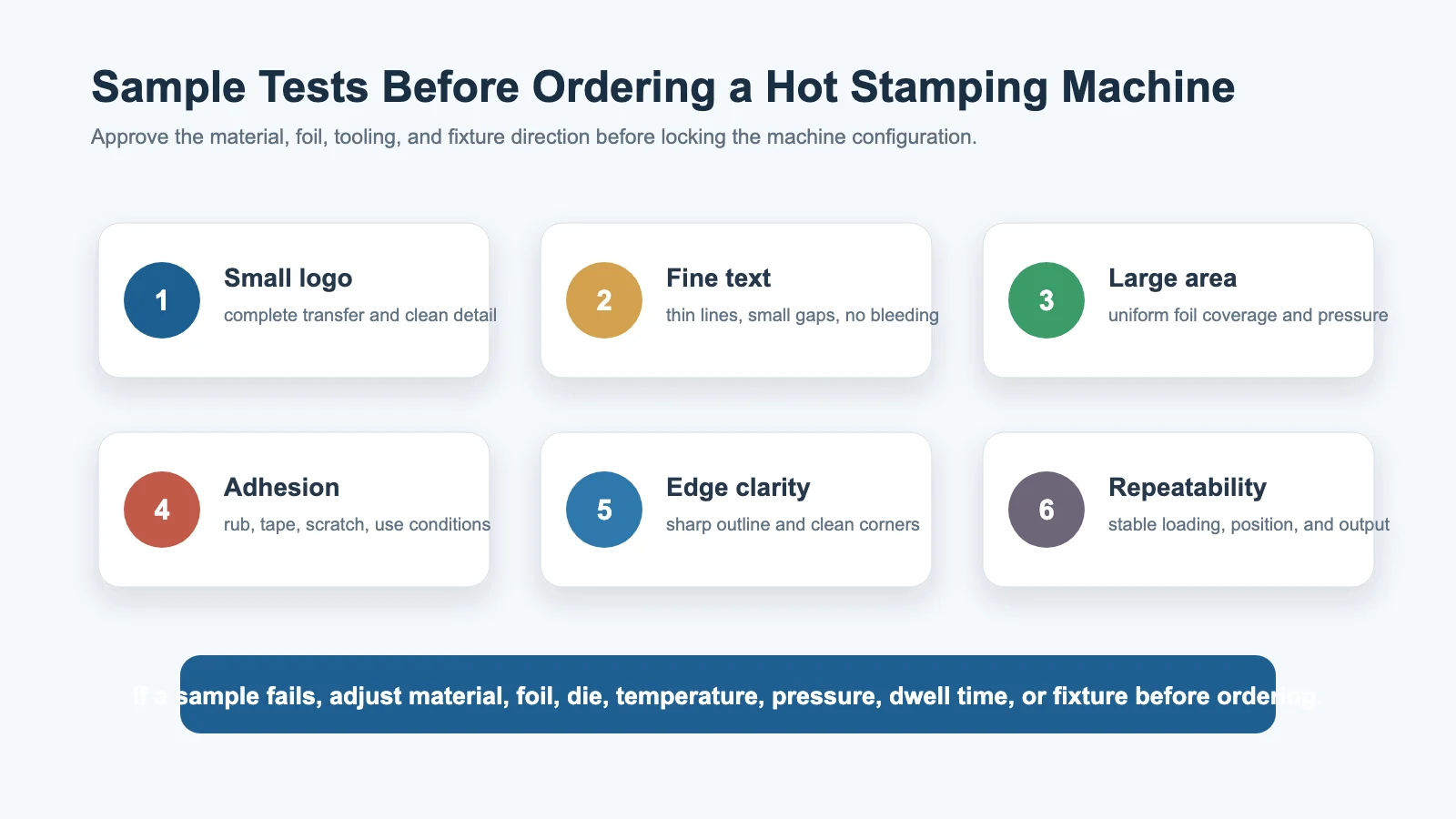
- Run a small logo test to check complete foil transfer, clean edges, no broken lines, no blurred corners, and no excessive pressure mark.
- Run a fine text and thin line test to check small gaps, thin strokes, missing lines, and foil bleeding.
- Run a large area test to check uniform coverage, pinholes, cloudy areas, wrinkles, uneven brightness, and material deformation.
- Run an adhesion test by rubbing, tape peeling, light scratching, or testing under the product's expected handling conditions.
- Check edge clarity under good lighting, especially for luxury packaging, cosmetic boxes, electronics packaging, gift boxes, and brand logos.
- Check positioning and repeatability across multiple samples, not only one good result.
For large-area hot stamping, pressure capacity and machine structure become more important. This is one reason buyers compare manual, pneumatic, hydraulic, and automatic hot stamping machine types.
How material testing affects machine configuration
The purpose of sample testing is not only to answer "can this material be stamped?" It also helps confirm the correct machine configuration.
- A small paper logo may only require a compact manual or pneumatic hot stamping machine.
- A large foil area may require higher pressure and a more stable platen structure.
- A rigid box may require a larger worktable or customized positioning fixture.
- A plastic cap may require special tooling, temperature control, and surface-specific foil.
- A curved product may need roller stamping or a custom fixture instead of a simple flat press.
- High-volume production may require automatic feeding, foil control, and repeatable positioning.
This is why two buyers asking for "a hot stamping machine for packaging" may need completely different solutions.
Inquiry checklist
What to send before asking for a machine recommendation
- Product photos from different angles.
- Material type, such as paperboard, laminated paper, PP cap, ABS part, coated surface, or textured paper.
- Material thickness or product dimensions.
- Surface finish, such as matte film, glossy coating, UV varnish, soft-touch coating, paint, or untreated plastic.
- Artwork file, preferably vector format.
- Stamping size, including logo width, height, and position.
- Foil effect, such as gold, silver, matte, holographic, pigment color, or special effect.
- Expected production volume per day or per hour.
- Quality requirement, such as fine text, large area, strong adhesion, scratch resistance, or cosmetic-grade appearance.
- Real samples for testing when possible.
Do not judge hot stamping feasibility only from photos
Photos are helpful, but they cannot replace sample testing. A photo cannot show surface energy. It cannot show whether the coating accepts foil. It cannot prove whether a plastic cap will deform under heat. It cannot confirm whether the foil will pass a rubbing or tape test after stamping.
For simple paper materials, a recommendation may be made faster. For laminated, coated, textured, plastic, or irregular packaging parts, real sample testing is strongly recommended.
Related PackFinish pages
- Hot stamping machine for gift boxes buyer checklist
- How to choose the right hot stamping machine for packaging products
- Manual, pneumatic, hydraulic or automatic hot stamping machine comparison
- Common hot stamping problems to check before buying
- Manual / semi-automatic hot stamping machine
- Contact PackFinish to send product details and sample requirements
FAQs about hot stamping material tests
Can all packaging materials be hot stamped?
No. Many paper, laminated, textured, plastic, and coated packaging materials can be tested, but the result depends on the exact surface, foil grade, die, heat, pressure, dwell time, and fixture.
Why should real samples be tested before ordering a hot stamping machine?
Photos cannot prove foil adhesion, heat resistance, edge clarity, or production repeatability. Real samples help confirm whether the material and machine configuration are suitable before purchase.
Can plastic caps and closures be hot stamped?
Many plastic caps and closures can be hot stamped, but testing is important because different plastics and coatings respond differently to heat, pressure, foil, and fixture design.
What should I send to PackFinish for a material test review?
Send product photos, material type, surface finish, dimensions, artwork, stamping size, foil effect, expected production volume, quality requirements, and real samples when possible.
Send sample materials before confirming the machine configuration
If you are not sure whether your packaging material can be hot stamped, the most reliable way is to send sample materials for testing.
PackFinish can help evaluate whether the material is suitable for hot stamping, which stamping area is practical, whether fine text or large areas can be achieved, whether adhesion is acceptable, whether the product needs a custom fixture, and which machine type is more suitable for your application.
Hot stamping quality is not decided by the machine alone. It is decided by the complete match between the machine, foil, die, fixture, process parameters, and packaging material.
Send your sample materials and packaging requirements to PackFinish before confirming your hot stamping machine configuration.